METHOD & PROCESS PRINCIPLE
Controlled cooling, continuous circulation, inline blending and temperature-managed transfer keep the heavy residue pumpable and stable without treating field storage as part of the process module.
 UNKA ENGINEERINGEPC CONTRACTOR
Cools, conditions and transfers stable heavy bottoms within viscosity and temperature limits.
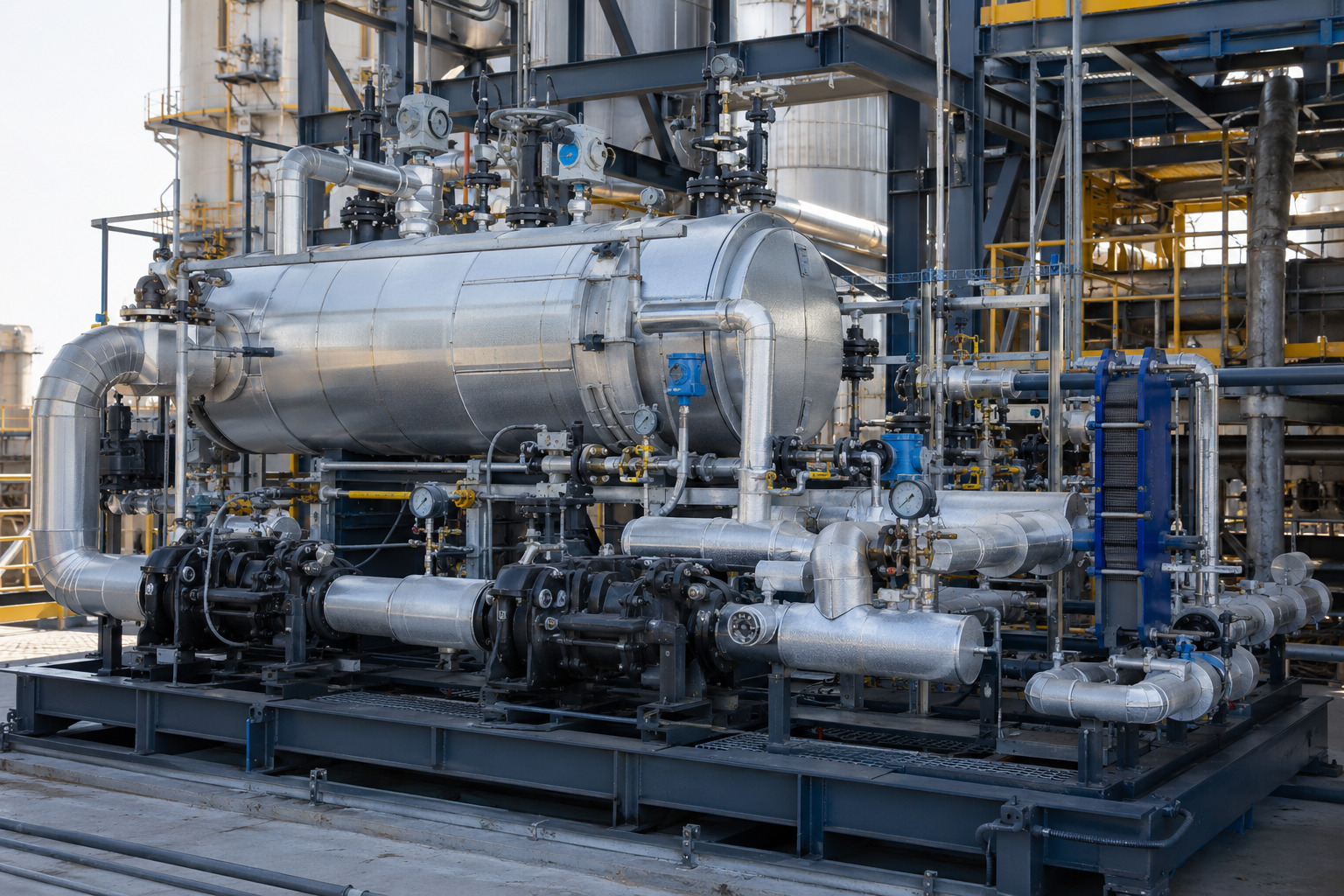
Controlled cooling, continuous circulation, inline blending and temperature-managed transfer keep the heavy residue pumpable and stable without treating field storage as part of the process module.
Heated residue surge drum, twin positive-displacement pumps, strainers, residue cooler/heat exchanger, inline blending manifold, steam-jacketed or electrically heat-traced piping, viscosity/temperature instruments and battery-limit transfer interface.
Residue yield, viscosity–temperature curve, softening point, stability, pour behavior, allowable residence time, transfer distance and downstream product route.
Design Basis, material balance, PFD, P&ID, equipment and instrument datasheets, line/equipment lists, control narrative, cause-and-effect, layout/3D interfaces, inspection plan, operating and commissioning procedures.
Closed handling, relief/vent/drain routing, alarms and trips, hazardous-area classification, HAZOP actions, maintainable isolation, fire protection and emergency shutdown interfaces.
Bitumen, heavy fuel, pitch-like residue or recycle handling subject to approved product route.
ASME VIII for the heated surge drum, ASME B31.3 for process piping, API 520/521 for pressure-relief interfaces and applicable EN/DIN/GOST material and product requirements.
ASME VIII for the heated surge drum, ASME B31.3 for process piping, API 520/521 for pressure-relief interfaces and applicable EN/DIN/GOST material and product requirements.